
Building a Culture of Conversation
Larry Richards
Introduction: Cybernetics
This note discusses what I will call “deep” conversation: its characteristics, its facilitation and its potential consequences. The conceptual framework from which this form of conversation derives has a basis in a field of inquiry called cybernetics – “conversation theory” to be specific. Cybernetics takes as key concepts: circularity (or recursion), process (or dynamics), possibilities and constraints (or variety and the retardation of its decay) and self-consciousness (or intention and participation). I use these concepts to present this form of conversation and the culture required for it to become pervasive. I argue that deep conversation offers an avenue to citizen participation in those affairs that affect them. Everyone, all humans, have a stake in building a culture of conversation at all levels of government and society – neighborhood, community, region, nation and world.
The Many Varieties of Conversation
Conversation comes in many forms. There is casual conversation, polite cocktail party conversation, small-talk, chit-chat, and so forth, all of which play important roles in society. I use the term “deep conversation” when I wish to speak of a particular dynamics of interaction among two or more participants, in a language, such that the dynamics moves from asynchronicity (manifest as a disagreement or conflict, friction, inconsistency – that is, being on different pages, therefore out of synch) toward synchronicity (manifest as agreement, including agreement to disagree – that is, acquiring greater mutual understanding, therefore becoming in synch). The language does not need to be natural language (like English, Spanish, etc.); it can also be visual, gestural, graphical, audial, movement, or symbolic, although natural language may provide the most variety, especially in combination with other languages.
Deep conversation focuses on the dynamics of the interaction, with the content of the interaction rendered a secondary role. So, unlike other forms of communication that are about the content, deep conversation requires of its participants listening for and responding to the dynamics. Standard communication is about coordinating behaviors and assumes sufficient mutual understanding to minimize the interaction. Deep conversation is about sustaining, changing and creating distinction and assumes a desire to learn from the differences among the participants. Participants enter into deep conversation voluntarily, exhibiting care and generosity, with a commitment to engaging the others in recurrent interaction.
The Two Tracks of Language
Conversation happens in language. Two tracks of language can be recognized: the descriptive (or representative) track – i.e., what is said, and the orientative (or injunctive) track – i.e., what “what is said” does. Sustaining a conversation requires listening for both tracks, with special attention given to the orientative track, the dynamics of the interaction. Listening for dynamics gives attention to amplitude, speed, rhythm, emphasis, pivot, event, inflection/pitch, etc. All participants give this attention in order to move the conversation forward and sustain it. Playing with the dynamics, by both speakers and listeners, is the performative aspect of deep conversation; it involves thought and intent.
The Process of Thought
The version of “thinking” I use here is the one that I experience and of which I am aware. It involves an awareness of an unfolding (stringing, sequential) or churning (chunking, non-linear), or both, of a set of concepts and the connections among them. We often speak of the connections as involving some form of logic, in which case we call the thinking “rational”. However, the connections are themselves concepts and subject to experiment. When the connections are experimental, possibly logic not yet recognized, the thinking may appear to be non-rational, as in poetry. Thinking can be said to arise from a conversation I have with myself, in a language, where the participants are different roles or perspectives I take on simultaneously. Thinking, then, also arises from the conversations we have with each other, in which case thinking becomes a social phenomenon as well as an individual one. The languages we share, verbal, visual, mathematical, etc., determine (constrain) the ways of thinking that we can employ, both individual and social. The conversations we have with each other, therefore, are key to exploring our languages and changing our thinking.
Paradigms: Patterns of Thinking
I use the word “paradigm” to speak of a way of thinking or pattern of thought (i.e., the ways of connecting), usually operating without the awareness of the individuals doing the thinking. Ways of thinking are carried by the languages participants use in their everyday activities or in the specialized communities of which they are members. Because the prevailing way(s) of thinking typically operates without awareness, the thinking that happens can be described as improvised – i.e., we think and speak whatever happens to come to mind. One of the important consequences of conversations among multiple people is that even slight differences in ways of thinking can generate new ideas that none of the participants themselves would have come up with on their own. Another possibility is that participants might become aware of different ways of thinking, turning the way of thinking into a choice. This turns thinking into a deliberate activity (rather than improvised), adding yet more variety to the conversations in which people participate. I have often described cybernetics as “a way of thinking about ways of thinking, of which it – cybernetics – is one,” turning cybernetics into a process (rather than a set of fixed concepts) and the way of thinking into a choice (rather than defaulting to the current prevailing paradigm).
Culture, Behavior and Constraint
Culture constrains human behavior. In addition to the prevailing way(s) of thinking, these constraints also include shared values, rituals, conformity of habits and taboos, etc. Artifacts, including artforms, architectures, technologies, etc., reflect the constraints of a culture and reinforce those constraints by our everyday interactions with them. Nuances in the languages of a culture carry differences in the constraints between one culture and another. It is likely through changes in language that changes in culture can be realized, and if those changes are to happen non-violently, they will happen in conversation. Unfortunately for those who would like to build a culture of conversation in the U.S. (and perhaps other Western nations and beyond), current culture there protects itself from change by discouraging deep conversation. Prevailing ways of thinking view the world as a game, with winners and losers. Competition and goal-based achievement rule, with reward-oriented hierarchies the way of thinking about how to organize the social structures deemed most likely to succeed against competitors, whether at the group, organizational or national level. A culture of conversation involves mutual learning and a shared stake in the well-being of each other. Heinz von Foerster’s adage, “A is better off when B is better off,” is accepted by all. Amity rules.
Values and Desires
Values carry particular significance in culture and conversation, both as topics and constraints. Values constrain the emotioning inherent in the interactions characteristic of a culture. Emotion is ubiquitous. Thinking and emotion go together, intertwined. Shared values provide guidelines for acceptable displays of emotion, limiting and enabling the dynamics of interaction, in conversation and in thinking. Deep conversation, and all it entails, needs to be a shared value in a culture of conversation – a culture where caring, thinking, listening, openness to change, generosity, and sustained interaction are valued.
Values also drive individual preferences and desires. How desires are formulated in a conversation can make a difference in the congeniality of the interactions and the sustainability of the conversation. For example, if formulated as goals and objectives (that is, as end points to be achieved in the future), participants may have difficulty finding common ground on which to proceed. On the other hand, if formulated as a set of constraints (that is, as a space of possibilities deemed acceptable in the present), participants can explore areas where their desires might overlap. Desires associated with deep conversation include the desire to learn, the joy of interacting with others, and possibly the hope of generating new perspectives, new insights, new alternatives to problematic situations. Overall, conversation addresses differences and conflicts among participants in a way that avoids violence.
Intention: Conversations For…
Conversation can have value irrespective of any outcome. In fact, a preestablished intention can get in the way of the possibilities that conversation has to offer. The joy of engaging with others and the possibility of learning are ends in themselves. Yet, we often engage in conversation in order to accomplish something specific – solve a problem, resolve a conflict, brainstorm options, formulate a strategy, agree to a vision, etc. Of course, participants must first agree to what they want to accomplish, which can be a conversation in itself. If participant desires are formulated as constraints (i.e., as what they want to avoid rather than as specific goals), then intention can be thought of as awareness of desires as a set of constraints. Then, the intention of a conversation guides both the possible outcomes as well as the conduct of the conversation itself, and allows for a change of intention as the participants move toward agreement and change themselves. This approach to conversation and intention also implies a shift from a consciousness of purpose to a consciousness of presence. A culture of deep conversation suggests a consciousness of presence.
Consciousness of Presence
Gregory Bateson argued that human purposiveness is dysfunctional. Human consciousness works by focusing in on a small part of a whole situation; that’s what makes it so effective. By focusing in on just a part of a whole, it fails to account for all the circularities that connect the parts together. Under a consciousness of purpose, the individual focuses in on a goal or objective to be achieved at some point in the future, and then selects what they determine is the best course of action to achieve it. This is not the way nature works; in complex situations, there are inevitably consequences that were unanticipated and often undesirable. The question is: Is there an alternative form of consciousness that allows us to keep the qualities it entails that is not dysfunctional? If intention is formulated as an awareness of desires as a set of constraints in the present, a space of possibilities opens up that provides the flexibility to accommodate many outcomes as well as changes in desires. Consciousness allows us to be present in the moment and still have intentions – a consciousness of presence. Goals and objectives can still have value in some situations, but we can be aware that there are alternatives on which to fall back. Conversation happens in the present, moment to moment, and in deep conversation participants need to be present, giving attention to the interactions and their dynamics.
Mechanisms of Participation
Democracy is about participation – government of the people, by the people, and for the people. When the scale of a government is such that people cannot participate in every decision on a day-to-day basis, a representative form of democracy at least gives people a way to participate through periodic election of their representatives. Once elected, representatives possess the power to make policy and enact legislation. Technology now exists that would allow people to participate to a greater extent in actual policy formation and decision-making, even on a large scale – a fully participative form of democracy. However, for everyone to have a voice, participation must take the form of local conversations for which ideas and consensus get aggregated to other levels of conversation. “Power” is no longer the way to talk and think about how individuals make a difference in the decisions that get made, as no one has power over anyone else. Participation (i.e., awareness of making a difference) is realized through the dynamics of conversations in which one participates, even when participants cannot trace their local conversations to specific global outcomes. They make a difference by contributing their unique perspectives, ideas and skills rather than obtaining power, the ability to “cause” things to happen.
Design for Conversation
In a participative-dialogic society, all organizations, all architectural structures, all technological devices are designed to conserve or enhance conversation as a critical feature of their realization whenever possible. Living rooms in homes have served a conversational role, some better than others. Comfortable gathering places with seating for smaller and larger groups in parks, apartment buildings, work settings, waiting rooms, schools, cafes, bars, public transportation vehicles, can all encourage conversation through their design. Organizations can be designed to include employees at all levels in important decisions; worker-owned companies are examples where conversation can be built into day-to-day routines. All technology mediates human interaction in one way or another; how it does this can be more or less conducive to conversation. Communication, transportation and computing technologies are obvious examples, but so are manufacturing, agricultural, health care, educational, retail, and home technologies.
Change Language, Change Thinking
So, how does culture change. If we can agree that current culture does not encourage deep conversation, perhaps even discourages it, what can we, concerned citizens who have little power or authority to change the systems that drive our everyday lives, do to build a different one – a culture of conversation? The ways of thinking and valuing that constitute our culture and that maintain our systems are carried in our everyday language – its vocabulary, grammar and syntax. Change language and you change thinking; change thinking and you change culture; change culture and you change values. So, how does a change of language happen? First, changes in language happen all the time, mostly without our awareness. We get bombarded with the language of mass media and then pick it up in our everyday interactions with each other.
Herbert Brün, the composer and cybernetician, argued that we need to change the language with which we talk and think about the idea of “peace”. He would say that “peace is a need” that must be attended to continually, not a desire that once achieved allows us to move on to other matters. For peace as a need requires conflict as the necessity that satisfies the need. When conflict is addressed with conversation rather than with violence, we have peace. Someone once observed that this is not how people currently talk or think about peace: how will that change? Herbert responded that you say it, then you say it again, and then again, and then others say it, and so on, until it becomes mainstream, the way people talk and think about it in their everyday lives.
Some related topics for further consideration: Education for Participation, Non-hierarchical Organizations, Governance and Economy, Responsibility and Accountability, Leadership: The Floating Hierarchy, Prospects: The End of Violence, Prospects: A New Age of Significance
Reflections
My friend John reviewed the above narrative, asked some thoughtful questions and made some constructive comments. Here is the text of the email exchange:
John: Can participants have a deep conversation via email? Can you script a deep conversation between/among participants and identify the dynamics of that conversation for the reader and so clearly separate them from the content?
Larry: This has been a highly debated question in cybernetics. I prefer to say that no, two (or more) people cannot have a deep conversation via email. I say that because the dynamics of interaction is so limited relative to what it is in face-to-face interaction, including movements, gestures, eye contact, surroundings, voice nuances, etc., not to mention that email is asynchronous with respect to responses to each other. In short, the intensity of dynamics that is so important in a conversation is not even close to what it is face-to-face. Email is good at communicating content.
Even in a Zoom interaction, the dynamics is limited--the visual is two-dimensional and much of the nuances get lost. Rather, I say that participants can have deep conversations with themselves via these media, where each creates some kind of "image" of the other with which each then interacts (often relying on a history with the other participants). I asked Gordon Pask this question with respect to teaching via video (including real-time), and he said that the role of the teacher is to present in such a way that it stimulates the students at the other end to enter into conversations with themselves, which can be valuable and contribute to their learning. The teacher who does that is an "entertainer", Gordon would say. (Note that Gordon saw deep learning as a phenomenon that happens in conversation.)
I also think that it can become quite dangerous when someone who is interacting through email actually regards themselves in a conversation with someone else. I've had occasion to observe someone who had a history of bipolar disorder do this, and it triggered an episode. As long as the person sees what they are doing as a conversation with themselves, they can choose to engage as such or to leave the interaction. However, when they treat the interaction as a conversation with another, they miss the dynamics that are so important for sorting out the frictions, differences, disagreements, conflicts, inconsistencies that are central to working through and sustaining the conversation.
Of all the media through which we can come close to having a conversation, the old analog telephone may be the best. The dynamics of the voice may be sufficient to keep the conversation going in a positive direction, but it may take a lot of work. It also can probably only work when the participants on the phone call know each other quite well and can project what they (the others) may be doing, dynamically, even if they cannot experience it directly. In my opinion, digital phones lose too much of the simultaneous dynamics of the voices.
John: Your “no” was what I was hoping for and your rationale on email as a deficient deep conversation medium reflects (more robustly than what I presented to myself) what I was thinking.
When I asked about scripting a deep conversation, I was thinking of what a playwright and actors do—integrate dynamics into content—I expect they do some fine parsing of dynamics versus content. It is this parsing that we non-actors need to get a handle on. It is what a writer does when she/he intends to present an unreliable narrator—the dynamics will run counter to the content.
What you have evoked for me are the conversations I have observed and initiated (ignited?) where the rules were broken. Each conversation in your litany of non-deep conversations, presented in your opening lines of the Many Varieties of Conversations as playing "important roles in society”, has its own rules. I have seen people with curious minds ask probing questions in the midst of a polite cocktail conversation for example—I heard these questions as displaying genuine intellectual interest and desire to learn (certainly that was my intent). Unfortunately, when the questioner failed to “read the room”, the recipient of the question was generally taken aback and would become defensive – others would rush in to change the subject and/or use humor to deflect the breaking of the understood conversational rules for this setting.
I am generally at “fault” here by asking about the use of a particular word and how nuanced the speaker had intended to be, which regardless of my honorable intent, evokes a defensive response.
From my previous life as a pilot—CRM—Crew Resource Management:
Where multi-pilot crews are concerned, pilots in command do well to remember that an essential element of leadership is strong communication. Pilots must speak up clearly and immediately with safety concerns, and pilots in command are responsible for listening carefully and seriously considering these apprehensions. The exchange of honest, useful feedback and confirmation of information exchange is also necessary.
While multi-pilot crews might seem safer because tasks are split and one pilot can step in if another is incapacitated during a flight, attention to crew resource management is vital here as well. Crews may unwittingly reinforce one another’s biases or incorrect information. They might feed one another’s eagerness to undertake a flight when conditions are unsafe. In addition, personality conflicts might hinder communication or distract from essential flying duties.
The word we most often used to alert the Captain that a “deep” conversation was needed was “Uncomfortable”—when the Captain heard that, the rules of conversation changed—generally speaking—the training spoke to this every year—but timely use of the word was also emphasized, as you can imagine.
On to conversations with oneself—I am wrestling with this—“deep” is a word that is a comparative—deep to you may not be deep to me or, conversely, really deep to me. A professor may entertain me and send me off to converse with myself—as a 17 year-old college freshman, I guarantee that self-conversation would be deeper than it would have been before, but on an objective intellectual scale it would no doubt have been described as “less superficial”. Without the foil of another, the depth of self-conversation suffers greatly and readily falls prey to (and may falsely reaffirm) known and unknown biases/beliefs. The self-conversation, while better than none at all perhaps, has, for me, a tough time living up to your description of the focus/description of a deep conversation in the third paragraph of your draft.
Larry: With respect to conversations we have with ourselves, I am in general agreement—conversations with others have far greater potential for learning and new insights. I treat the experience of thinking as arising out of a conversation I have with myself. The experience itself I characterize as an awareness of an unfolding or churning of a set of concepts and their connections; I explain that process as generated by some inconsistency or friction or asynchronicity that I want to resolve. I don’t usually question the source of those inconsistencies/frictions/asynchronicities; however, if I was to trace the source, I would arrive at two perspectives or roles or positions (these are the participants in conversations I have with myself). The interactions or conversations between these differing perspectives/roles/ positions is what generates the concepts and their connections.
With respect to a script for a conversation, as in a play or novel, the writer often includes some cues for certain dynamics (e.g., “spoken softly” or “quickly” or “angrily”). This can be in the form of emotions to which the actors or readers might relate. These cues serve as constraints on what the actors/readers do when they are engaged in the dialogue, but everything else is left to the performers. That is why the exact same play can be performed in multiple ways with no deviation from the script. The performers are “playing with the dynamics of interaction” (with the possibility of stimulating a conversation among audience members, among performers, between audience and performers, or in audience members with themselves).
The same can be said for the dynamics of a musical composition; the composer specifies some dynamics, which serve as constraints on the performer. Visual art is a little different; if the piece involves no movement, it is the viewers eyes that are moving across the piece, from one part to another, from the whole to the parts, from idea to idea, etc. The artist is invoking dynamics (hence emotion) by how he/she composes the piece. Different viewers can have quite different experiences from viewing the same piece. The artist sets some constraints within which viewers bring their individual histories.
John: I really like what you’ve done and where you are going. I find myself rocking back and forth at “content of the action rendered a secondary role”—my rocking a subject for conversation.
When you write “for example” and provide one, I am really drawn to that. I find it grounds me.
“Playing with the dynamics…is the performative aspect…” in the Two Tracks of Language paragraph strikes a discordant chord. Again I need a conversation about this because play and perform in the context of a deep conversation surface for me a behavior that is generally not authentic unless all participants are made aware that it is play. For example: in a deep conversation I become aware of my closed, defensive body language and I deliberately open myself up physically. I’m adjusting to the dynamics—indeed, I think it might be useful to say, I’m all closed up and wonder why. So I see myself adjusting, not playing, and presenting a behavioral aspect of a deep conversation, not a performative one. Obviously some of my constraints at work here.
Larry: With the word “play”, I want to convey a spirit of experimentation, a letting go and having fun. I use the word “performance” to speak of a sharing of what one wishes to share in a way one wishes to share it. In a conversation, this includes participating such that the conversation might continue rather than being brought to a halt before its time. Dismissals, defensiveness, anger, boredom, etc., all work to stop the interaction prematurely. I regard performance in conversation to be genuinely “authentic”; a conversation would not work otherwise.
John: As I thought about the paragraph on The Two Tracks of Language, the image of a DNA double helix came to mind—how each language track—dynamics and content—intertwine and build bridges with each recursion in the conversation.
Larry: That’s a reasonable image. The two strands work together, simultaneously, yet don’t intersect.
John: In addition to non-intersection of the strands, there are the connections made between them in the image. So content inspires an adjustment of dynamics which in turn inspires the altering of content which in turn…
I would submit that everyone of almost any age has had one or more deep conversations. They might not be able to characterize/describe that conversation with the clarity your draft does, nor even reflect on the dynamics. We, certainly I, have fallen into these conversations out of some felt need on the part of the participants. Dare I say, the need for deep conversations is in our DNA.
Larry: The non-intersection is a consequence of logic. The two domains – relations and dynamics – are of different logical type. They create a dialectic that comes together in us – the observers, participants, actors – and our conversations. We make the connections.
I am not sure that I would say that the need/desire for deep conversation is in our DNA, except perhaps metaphorically. I would say that the need for perturbations to our systems/processes is in our DNA: that’s what keeps those systems/processes abuzz, so to speak. It is a way that living systems retard the decay of variety. Conversation is one of the best (maybe the best, but not only) sources of perturbation to our (human) mental/emotional/social lives.
While almost everyone has likely experienced a deep conversation, our culture is not one that celebrates it; in fact, I would argue that, in general, it discourages it with respect to the “big” issues/questions (universities have tried to counter that through the teaching of critical thinking but have not been very successful). I claim that the biggest obstacles are driven by organized religion, for-profit corporations and political parties.
John: You point to dynamics and relations as the two domains. I was focused on dynamics and content as the two tracks (domains?) of the double helix. I hadn’t considered relations.
Your point on conversation as a source of necessary perturbation was a real ah ha moment—thanks—I’d suggest that really needs to make the book.
Last paragraph on not celebrating conversation and obstacles—you rounded up my usual suspects—not a coincidence that I learned at my mother’s knee that the two things I wasn’t to bring up were religion and politics.
Next question: Reference your first sentence in Design for Conversation—do you have an example of an architecture designed to conserve or enhance conversation? I’ve thought about this sentence in terms of a painting which does not change but viewed many times over time generates a distinctly different internal conversation as I have changed. Art enhances conversation. How does it conserve it?
Larry: In the context of language, I use the word "content" to talk about descriptions and explanations. Descriptions/explanations arise in language out of the domain of relations, rigidifying our (socially) constructed world. The domain of dynamics is elusive. Of course, we talk about dynamics, but as soon as we do they (dynamics) become a part of the content, of the world we describe and explain. The second track of language, the orienting/injunctive track, is a way to get a "glimpse" of that domain and to account for it in the performance of language. To some cyberneticians, the two tracks of language (the double helix), working together, generate a process they call "languaging". The concept of language shifts from the traditional one of "representing" the world to one of "coordinating" our mutual behaviors (actually, coordinating the coordination). Conversation, however, is not about coordinating our behaviors, although that does occur; conversation takes advantage of the orienting track in order to create a dynamic of interaction unique to humans (a way to satisfy a preference for recurrent interaction with others). Conversation brings us face-to-face with the domain of dynamics, so to speak.
I've included some examples of design for conversation. I would say that a work of art helps conserve conversation by "perturbing" the viewer (listener, audience, etc.) and hence generating opportunities for conversation (with themselves, with the artist, with other viewers). Without the arts (broadly construed), awareness of the idea and value of conversation might languish. So, for me, the arts do more than enhance our lives; they are essential to our well-being.
Appendix: Democracy
I use the word “democracy” when I wish to speak of a form of government that is “of the people, by the people and for the people”. How the people of a nation/state “feel” about their participation in governance processes indicates the extent to which their government exhibits the qualities of a democracy. There are no “external” or “meta” criteria; it’s about the people and whether they consider themselves to have a genuine voice, to make a difference.
I make some assumptions about the people in a democracy, their knowledge and values, including: (1) that the people are sufficiently educated in the processes of their government to understand what it is to participate; (2) that the people are sufficiently informed on a day to day basis about the status of their nation/state and its citizens to make judgments about the effectiveness of current governance processes and the possibilities for change; and, (3) that the people value participation, dialogue and basic freedoms for all (e.g., freedom to speak and assemble, freedom to worship, freedom from want, and freedom from fear).
As a practical matter, most democracies are representative, although representation can take many forms. Fully participative, consensus-based democracies have worked on a small scale and show some promise on a larger scale when technology-facilitated. There are forms of democracy that do not currently exist in any nation-state and likely some that have not yet been imagined.
The Tool: The Cycle of Intelligence
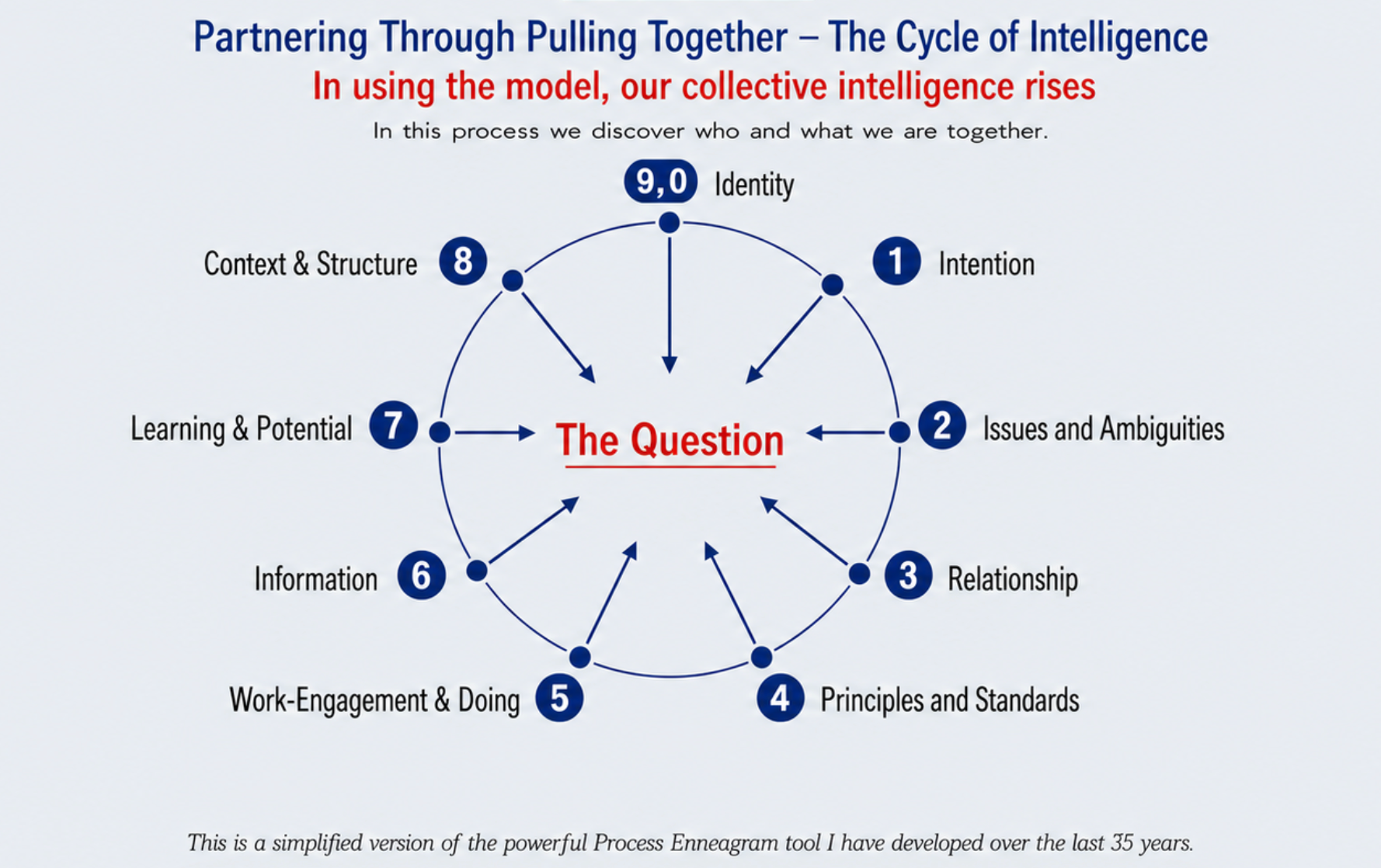
©Copyright 2022 Richard N. Knowles and Associates, Inc. All rights reserved.
Join the Conversation
America’s 250th anniversary is a time to look back — and to think seriously about what kind of democracy we want to carry forward. The Forum invites citizens, educators, community leaders, and others interested in civic renewal to explore new essays, emerging models, events, and conversations about how we can talk, think, and participate more constructively in democracy’s next chapter.
© 2026 The Forum, Inc. All rights reserved. Site by The Aspen Press.