
The Cycle of Intelligence
By Richard Knowles
Overview
The Cycle of Intelligence brings a diverse cross-section of citizens together in a safe, facilitated setting to explore a shared and compelling question from nine interconnected perspectives.
By sharing knowledge, listening to different viewpoints, and identifying new possibilities, participants can move beyond frustration, build shared understanding, and develop a practical plan for collective action.
Best suited for: Communities and organizations that feel stuck and need a structured path from frustration to shared understanding and action.
The Problem
Communities facing complex problems can become frustrated, divided, and uncertain about how to move forward. People may feel that government leaders or outside organizations must solve the problem for them, leaving citizens feeling unheard and powerless.
Trust can erode when past promises have not produced meaningful change, when leaders fail to listen, or when outside solutions do not reflect the community’s circumstances, relationships, or lived experience.
Yet communities often already possess much of the knowledge, experience, and ability needed to address their challenges. The difficulty is that this knowledge is dispersed among many people and may never be brought together.
Citizens need a practical way to gather in a setting where they can think aloud, listen to one another, share what they know, learn from different perspectives, and decide together how to act—without outsiders prescribing the answer.
The Solution
The Cycle of Intelligence provides a simple, structured framework for this kind of civic conversation.
A cross-section of citizens comes together around a complex and compelling question. With the support of a facilitator, participants create a safe environment in which they can speak openly, listen carefully, examine the issue from multiple perspectives, and discover possibilities that may not have been visible before.
The process helps participants move from frustration and uncertainty toward shared understanding, practical decisions, and coordinated action. Rather than waiting for others to solve the problem, citizens begin to recognize and use their own collective knowledge and capacity.
The Cycle of Intelligence has been used in hundreds of workshops with participants from different educational backgrounds, organizations, communities, and countries.
The Process
The process begins by bringing together a sufficiently diverse group of citizens who share a compelling and complex question.
In a structured, facilitated conversation, participants explore that question through nine distinct but interconnected perspectives. See the diagram below. Together, they clarify their intentions, examine relationships and information, establish principles for working together, consider the broader context, and identify opportunities for action.
The group also develops its own agreements for participation, helping to create a setting in which people feel safe speaking honestly and listening to others. Key ideas are recorded where everyone can see them, allowing participants to build on one another’s contributions and create a visible record of their shared work.
Outcome
For some participants, this may be the first time they feel genuinely heard. Knowledge that was previously scattered begins to come together. New insights and possibilities emerge, energy and creativity grow, and participants develop a shared plan they can put into action.
The Tool: The Cycle of Intelligence
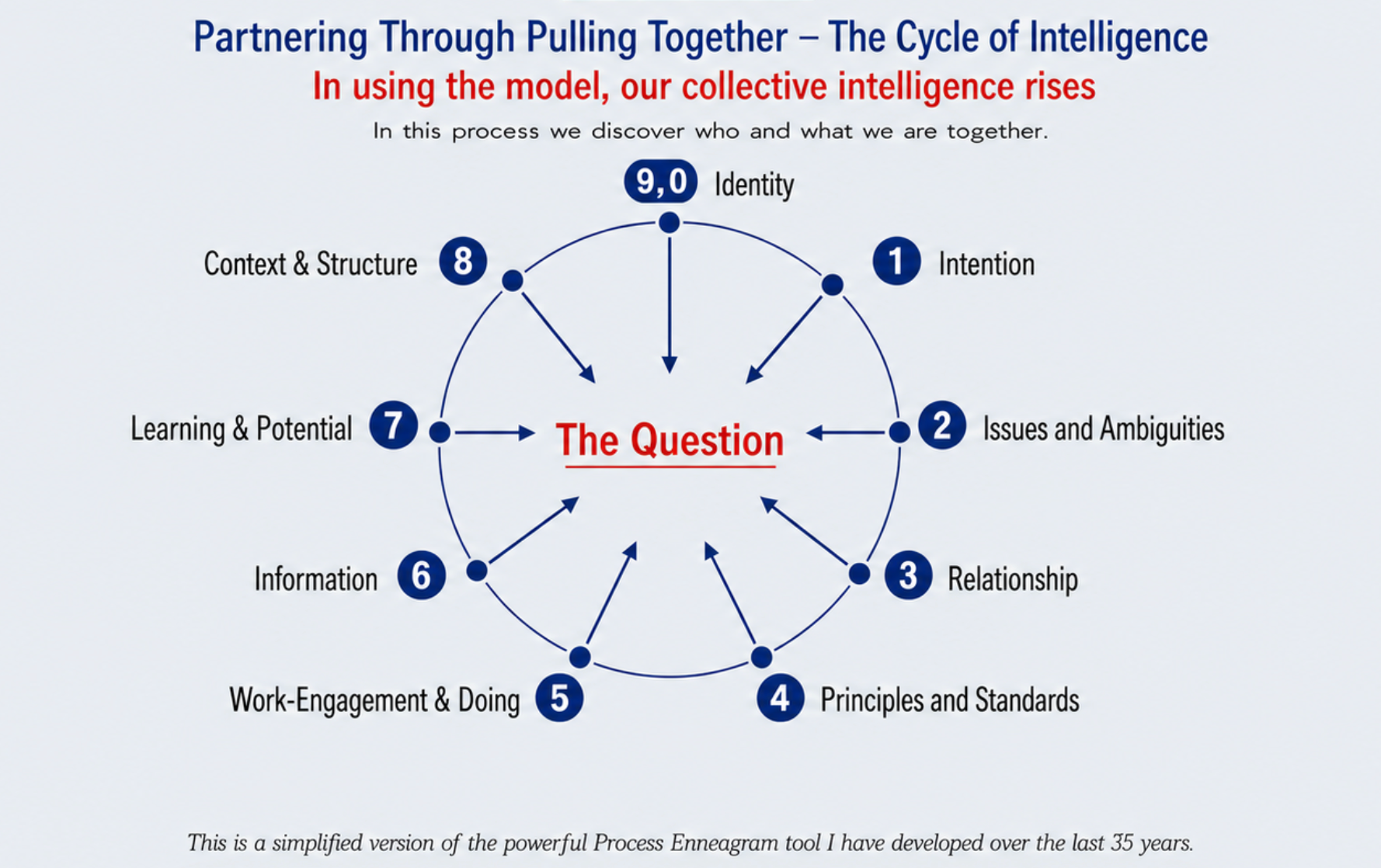
©Copyright 2022 Richard N. Knowles and Associates, Inc. All rights reserved.
Join the Conversation
America’s 250th anniversary is a time to look back — and to think seriously about what kind of democracy we want to carry forward. The Forum invites citizens, educators, community leaders, and others interested in civic renewal to explore new essays, emerging models, events, and conversations about how we can talk, think, and participate more constructively in democracy’s next chapter.
© 2026 The Forum, Inc. All rights reserved. Site by The Aspen Press.