
The Institutional Compass: Method, Use and Scope (Methodos Series, 18)
By Michèle Indira Friend (Author)
Format: Hardcover
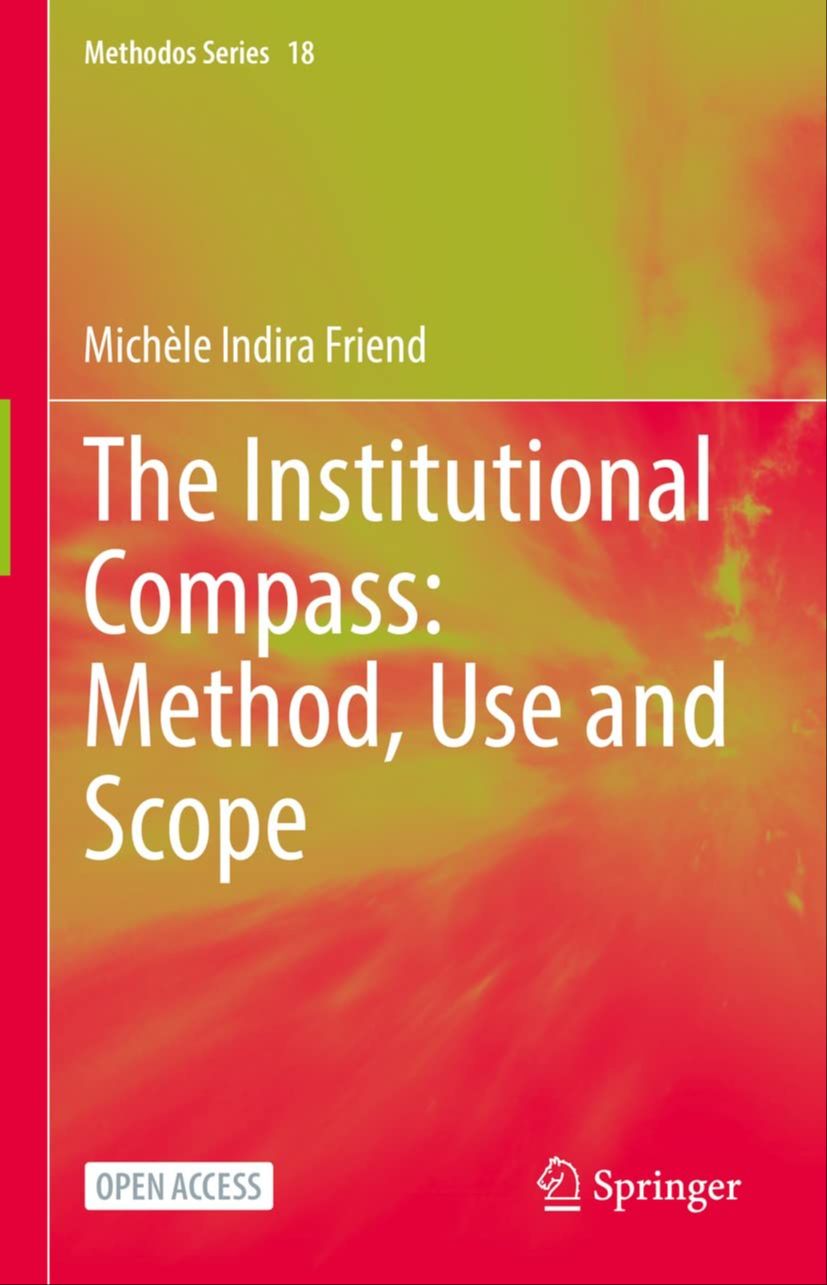
This open access book presents a new generation multi-criteria, multi-stake holder, decision aide, called an "institutional compass". Based on hard data, the compass tells us what quality-direction we are heading in as an institution, region, system or organization. The quality is not chosen from the usual scalar qualities of: good, neutral and bad. Instead, it is a quality chosen between: harmony, discipline and excitement. None is good in and of itself. We need some of each.
This open access book presents a new-generation, multi-criteria, multi-stakeholder decision aid called an “institutional compass.” Based on hard data, the compass indicates the qualitative direction in which an institution, region, system, or organization is heading.
The quality is not measured using the usual scalar categories of good, neutral, and bad. Instead, it is considered in terms of harmony, discipline, and excitement. None is inherently good on its own; some measure of each is needed.
The compass marks a new generation in four respects:
- The representation of the data is intuitive and easy to understand and can therefore be used to communicate and justify policy decisions.
- Any type of data can be included; none is automatically excluded. This allows the compass to be tailored to particular situations, voices, and contexts.
- The data can reflect different time horizons and different types of value, including monetary, practical, social, sentimental, religious, intrinsic, and existential value.
- The process of constructing the compass can be made inclusive at several stages. An institutional compass can also be adapted to evaluate products, add normative considerations to a systems analysis, reflect worldviews such as ecological economics, or function as an accounting system for managing scarce resources.
There are four parts to the book. The first part introduces the general ideas behind the compass. In the second part, the author presents the method for constructing the compass. This includes data collection, data analysis and a mathematical formula to aggregate the data into a single holistic reading. In the third part, the author extends the methodology: to incorporate it into systems science, adding a normative and quality-direction dimension, to use it as a non-linear accounting method and more thoroughly to reflect the philosophy of ecological economists to give a real measure of sustainability. In the fourth part, we see three case studies: one for the World Health Organisation, a second is the use of the compass to label products in a shop and the third is as a regional compass for Hauts-de-France. The book ends with philosophical conclusions.
Throughout the book, we see tight arguments, refreshing ideas and a thorough treatment of objectivity in decision making.
Join the Conversation
America’s 250th anniversary is a time to look back — and to think seriously about what kind of democracy we want to carry forward. The Forum invites citizens, educators, community leaders, and others interested in civic renewal to explore new essays, emerging models, events, and conversations about how we can talk, think, and participate more constructively in democracy’s next chapter.
© 2026 The Forum, Inc. All rights reserved. Site by The Aspen Press.